Biopolymer Development
Develop novel biodegradable packaging materials derived from seaweed and marine algae, replacing petroleum-based plastics.

SUSHI-PACK is a collaborative research project funded by the European Union under the Horizon Europe programme. The project brings together leading research institutions across Europe to develop the next generation of biodegradable packaging materials derived from marine resources.
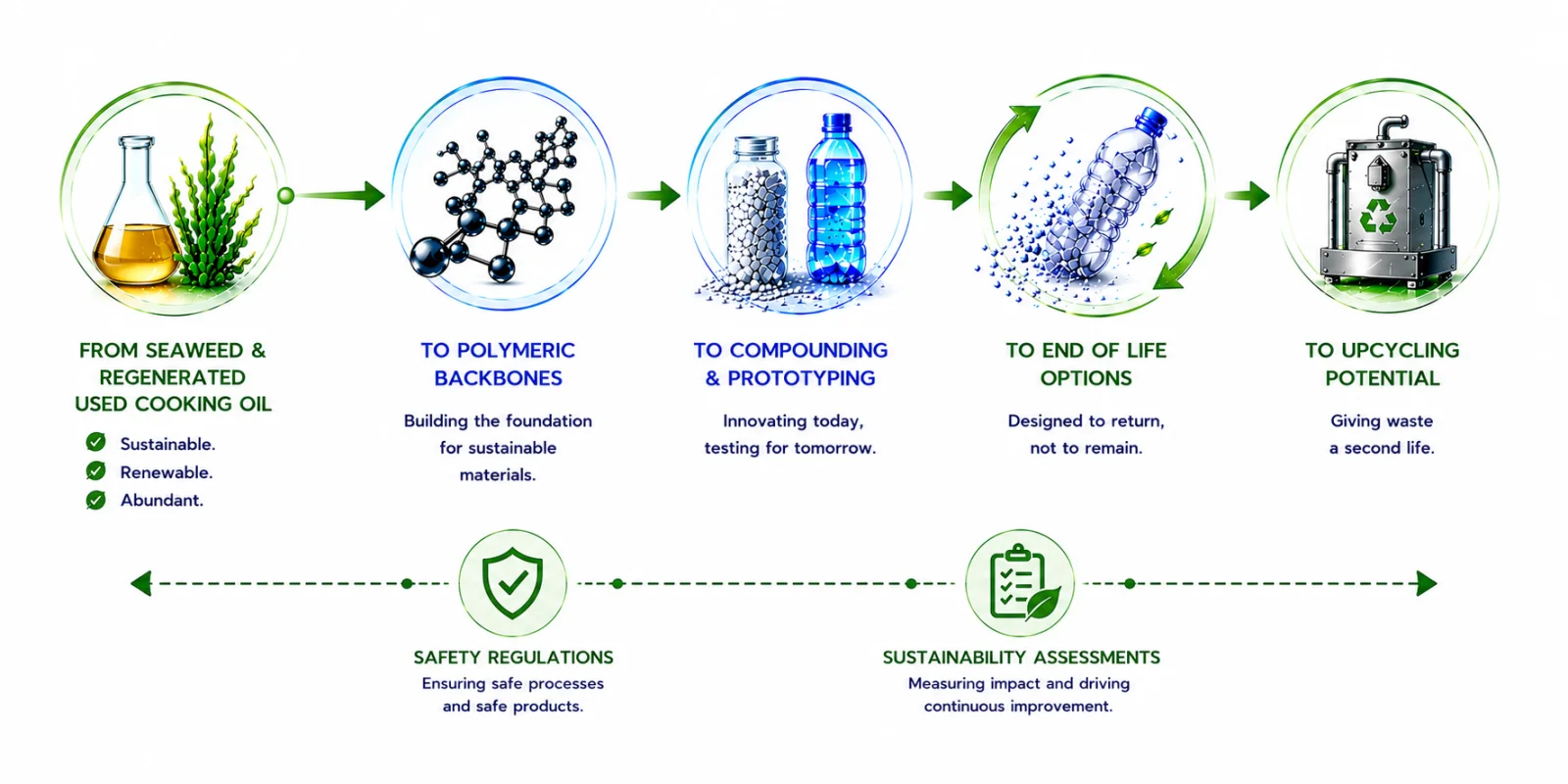
From renewable feedstocks to upcycling potential — the SUSHI-PACK value chain at a glance, with cross-cutting safety regulations and sustainability assessments at every stage.
In 2018, EU packaging generated a staggering €355 billion, with waste levels soaring to 84 million tons by 2021, as each European produced nearly 189 kg of packaging waste — a figure expected to reach 209 kg by 2030, if lack of crucial actions. With the EU's provisional Packaging and Packaging Waste Regulation set to revolutionize the industry — mandating 100% recyclable packaging, banning toxic chemicals, and eliminating single-use plastics by 2030 — the need for innovative, sustainable materials has never been more urgent. The SUSHI-PACK project rises to this challenge, aiming to develop cutting-edge, bio-based packaging inspired by natural cuticles and cell walls, using functionalized polysaccharides derived from seaweed and bio-based synthons from Regenerated Used Cooking Oils (RUCO). This groundbreaking approach not only enhances food shelf life and biodegradability but also ensures scalability and compliance with safety regulations through advanced biocatalytic processes and the Safe and Sustainable by Design (SSbD) Framework, positioning it to meet the EU's bold target of reducing packaging waste by 15% by 2040.
Four interlocking goals that guide every work package in SUSHI-PACK.
Develop novel biodegradable packaging materials derived from seaweed and marine algae, replacing petroleum-based plastics.
Design cost-effective, industrially scalable production processes for marine-based biopolymer packaging solutions.
Assess the environmental footprint and circular economy potential of seaweed-based packaging across its full lifecycle.
Ensure all developed materials meet EU food-contact regulations, safety standards, and recyclability requirements.
SUSHI-PACK is redefining sustainable packaging by developing next-generation bio-based materials that combine environmental responsibility with high performance. Our approach centers on creating compostable packaging solutions that naturally biodegrade while delivering superior mechanical strength, flexibility, and advanced barrier protection.
Inspired by the natural architecture of plant cuticles and cell walls, we design innovative layered and blended materials that not only protect goods but also introduce smart functionalities such as self-healing, oxygen-trapping, and hydrophobic properties. This ensures reliability across diverse industries while setting a new benchmark for eco-friendly packaging.
At the core of our technology is the use of sustainably sourced seaweed-derived polysaccharides — particularly alginate and agar — combined with regenerated used cooking oil (RUCO) as a secondary raw material. Through advanced metabolic engineering and biocatalysis, RUCO is transformed into hydroxy fatty acids (HFAs), which serve as key building blocks for producing polyesters, polyester-urethanes (PEUs), and modified polysaccharides.
These materials are engineered into blends and multi-layer structures that deliver:
Our development process is guided by the Safe and Sustainable by Design (SSbD) framework, ensuring that all materials, additives, and technologies meet stringent environmental, social, and regulatory standards. Life Cycle Assessment (LCA) is integrated throughout to identify optimization opportunities and minimize environmental impact.
SUSHI-PACK also prioritizes circularity at every stage. End-of-life scenarios — including compostability, biodegradation, and enzymatic hydrolysis — are thoroughly evaluated. Importantly, hydrolyzed materials can be revalorized as feedstock for producing high-value biopolymers such as polyhydroxyalkanoates, closing the loop on material use.
By combining biotechnology, material science, and sustainability principles, SUSHI-PACK delivers viable alternatives to fossil-based plastics — targeting at least a 15% reduction in greenhouse gas emissions while enabling strong economic potential.
A portfolio of environmentally friendly materials and use cases informed by availability, efficiency and end functionality.
Creation of nature-inspired prototypes aimed at achieving circularity and improved biodegradability.
Production of hydroxy fatty acids (HFAs) from regenerated used cooking oils (RUCO) through advanced metabolic engineering and biocatalysis.
Synthesis of polymeric backbones through transesterification reactions using HFA-based building blocks.
Development of polyesters and polyester-urethanes (PEUs) via controlled ring-opening polymerization processes.
Engineering of multi-layer and blended packaging materials; processing optimization and characterization of mechanical, barrier, and degradation properties.
Compliance assessment with EU food-contact and packaging regulations, including SSbD framework alignment and safety standards.
Evaluation of biodegradation, compostability, and enzymatic hydrolysis pathways; revalorization of hydrolyzed materials into high-value biopolymers.
Comprehensive Life Cycle Assessment (LCA), techno-economic analysis, and Safe and Sustainable by Design (SSbD) integration across all materials and processes.
Strategic project oversight, consortium coordination, financial management, and reporting to the European Commission.
Communication of project results to stakeholders, policymakers, scientific community, and the broader public; visual identity and outreach activities.
🇪🇺
This project has received funding from the European Union's Horizon Europe research and innovation programme under Grant Agreement No. 101257388. Views and opinions expressed are however those of the author(s) only and do not necessarily reflect those of the European Union or the European Research Executive Agency (REA). Neither the European Union nor the granting authority can be held responsible for them.